
Data-Backed Analysis for Global Careers, Business, and Digital Growth

Source: https://commons.wikimedia.org/wiki/File%3AWorld_map_percentage_english_speakers_by_country.png

Source: https://en.wikipedia.org/wiki/File%3AEnglish-as-Official-Language_Map.png

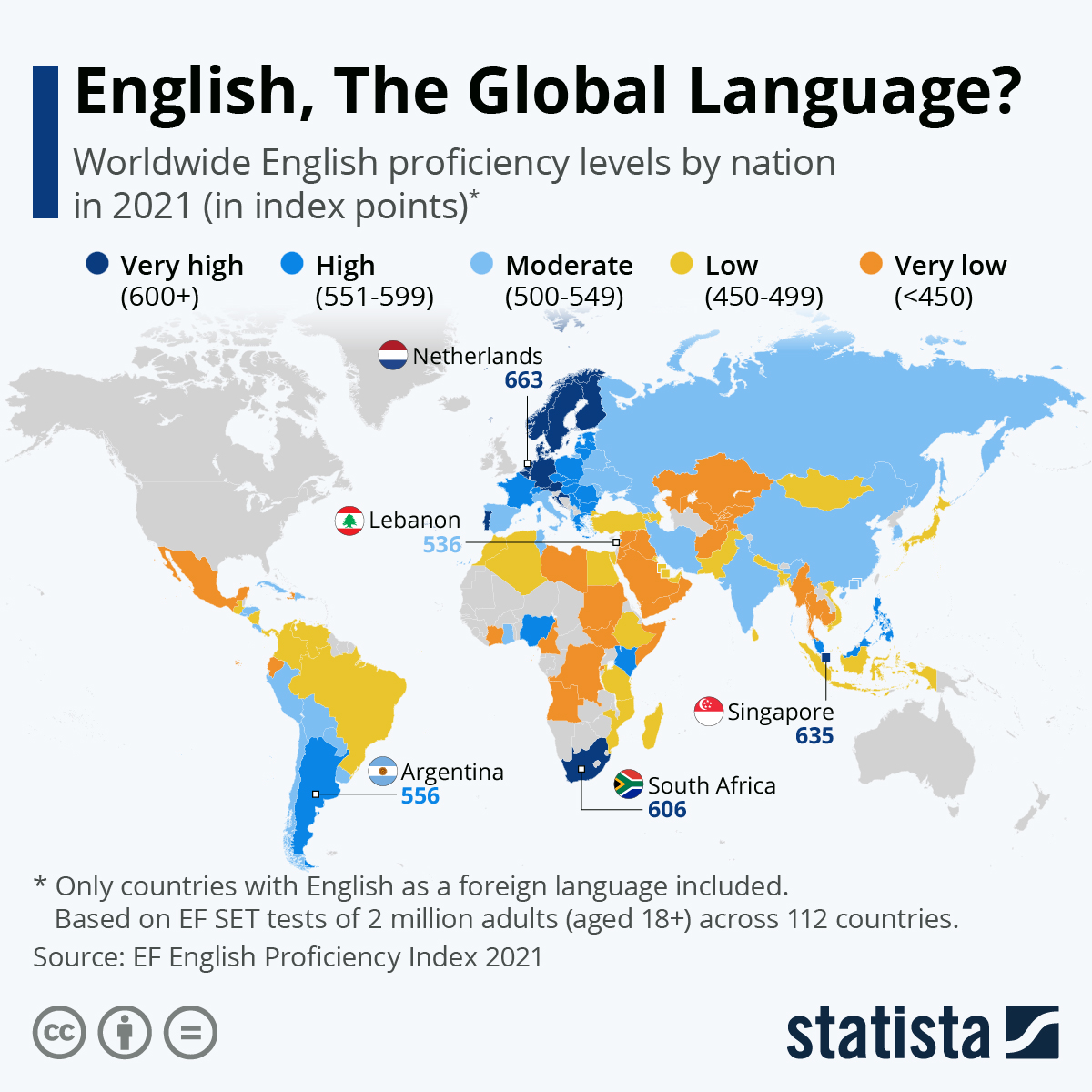
Introduction
English is not just widely spoken—it is institutionally embedded into global systems including governance, business, science, and the internet.
According to linguistic and geopolitical datasets:
- English holds official status in 55+ countries.
- Across 70–75+ regions, it serves administrative and working functions.
- Additionally, it operates as a global lingua franca in 80+ regions.
These figures align with compiled datasets from:
- Ethnologue (2024 edition)
- British Council global English reports
- UN language usage frameworks
This establishes English as the most geographically distributed language in the world.
Verified Global Data: English by the Numbers
| Metric | Value | Source |
| Total English speakers | ~1.5 billion | Ethnologue (2024) |
| Native speakers | ~370 million | British Council |
| Countries with official status | 55+ | UN / Wikipedia linguistic datasets |
| Countries with functional usage | 70–75+ | Linguistic surveys |
| Internet content in English | ~50–55% | W3Techs (Web Technology Surveys) |
Key Insight
English dominates 3 high-value global layers:
- Economic Layer → Business, trade, SaaS
- Knowledge Layer → Research, education, AI
- Digital Layer → Internet, coding, platforms
Why English Became the Global Standard

Source: https://en.wikipedia.org/wiki/British_Empire#/media/File:British_Empire_1921.png
1. Colonial Infrastructure (British Empire)
English spread through governance systems across:
- India
- Nigeria
- Kenya
- Southeast Asia
These countries retained English for administration and education systems post-independence.
2. US Economic Dominance (20th–21st Century)
The rise of the United States positioned English as the default language for:
- Global finance
- Technology ecosystems
- Multinational corporations
3. Internet and Technology
- Over 50% of all websites are in English (W3Techs)
- Programming languages and documentation are predominantly English-first
4. Institutional Adoption
English is an official or working language in:
- United Nations
- European Union
- African Union
Where English Is Official or Dominant
Africa
- Nigeria, Kenya, Ghana, South Africa
- Used for governance across highly multilingual populations
Asia
- India, Pakistan, Singapore, Philippines
- Functions in education, judiciary, and corporate systems
Americas & Caribbean
- Jamaica, Barbados, Trinidad & Tobago
- English used officially across governance and education
Europe & Oceania
- UK, Ireland, Australia, New Zealand
- Native-dominant English ecosystems
English as a Global “Bridge Language”
English acts as a lingua franca—a shared communication system across different native languages.
Examples:
- Nigeria: 500+ languages, English unifies administration
- India: 22+ official languages, English bridges interstate communication
This role is structural, not optional.
Why English Is a High-ROI Skill (Data + Strategy)
1. Career Leverage
- 90%+ of multinational companies require English proficiency (LinkedIn Global Hiring Trends)
- English speakers access higher-paying global roles
2. Business & SaaS Growth
- Global customer acquisition depends on English-first communication
- Product-market fit scales faster with English distribution channels
3. Knowledge Access
- Majority of academic papers published in English (Elsevier / Scopus data)
- Top learning platforms (Coursera, edX) are English-dominant
4. Digital Dominance
- YouTube, AI tools, and developer ecosystems are primarily English-first
Strategic Reality: The Real Bottleneck Has Shifted
The bottleneck is no longer startup creation—it’s distribution.
- Tech creation cost ↓ (AI, no-code, APIs)
- Time to MVP ↓ (weeks instead of months)
- Market saturation ↑
What wins now:
- Communication
- Positioning
- Global reach
And all three depend heavily on English proficiency.
Learn English with Qlango
Most language platforms rely on passive methods (reading/listening).
Qlango uses an active-learning model backed by cognitive science:
Core Advantages
- AI to Ask the Why – Contextual Chat for Deeper Understanding
- Repetition for Retention – Scientifically Sequenced Practice
- Interactive Learning Ecosystem – Games, Stories, Quizzes, and Flashcards
- Pronunciation Practice Pro (Alpha) – Intelligent Speech Accuracy
- Learn in Your Language – Inclusive by Design
- Structured and Certified Learning – CEFR-Aligned Progress
- Enterprise and Education Administration – Control, Insight, and Scalability
- Qlango Offline – Learn Anywhere, Anytime
👉 Explore supported languages and CEFR levels:
https://qlango.com/supp-languages/
Start Learning English with Qlango
Choose Your Platform:
- 📱 Android
- 🍎 iOS
- 🌐 Web App

